Everyone has heard of the dwarf elephants of Sicily or of the giant birds from Madagascar, these impressive animals are the results of a relatively well-known evolutionary phenomenon driven by natural selection. Small-animal gigantism and large-animal dwarfism in relation to mainland relatives are some of the most spectacular patterns known as the “island effect”. Although less iconic, some species in the Canary Islands have undergone some of the most extreme size changes documented in the fossil record. Canariomys, the giant rat of Tenerife weighted 1.4 kg and was 14 time larger than its closest relatives of the continent. Although some recent studies of the giant and dwarf insular species show some drastic changes in the evolution of the brain, the morphology of the brain of Canariomys had not been described until now.
A recent study, published in the Journal of Mammalian Evolution explored the brain morphology of two species including Canariomys bravoi (that lived in Tenerife) and Canariomys tamanari (from Gran Canaria). Flavien Vincent, main author and PhD student at the Museum d’Histoire Naturelle de Paris states: “with this huge change in size we wanted to know how the brain and the senses of these animals had evolved”. Since it is impossible to study the behaviour of extinct species the same way as behavioural ecologists do with modern-day mammals, paleoneurologists (paleontologists focusing on the nervous system of extinct species) use the imprint of the brain against the endocranial cavity to study its morphology and the difference in proportions existing between brain regions. In order to do that they work on 3D images acquired by X-ray methods (Computer Tomography scanning). “These images, like an MRI done in a hospital, provide the opportunity to study the specimens without damaging them”, explains Ornella Bertrand, senior author and Ramón y Cajal researcher at the ICP.

Side‑by‑side skulls of the mainland African grass rat (Arvicanthis, left) and the extinct Canary Islands giant rat (Canariomys, right) highlight the dramatic body‑size increase that evolved after the former colonized the islands (adapted from Vincent et al., 2025).
Genetic and morphological evidence indicates that both species of Canariomys probably originated from small founder populations of the African grass rat Arvicanthis niloticus that passively rafted to the Canary Islands from the nearby mainland about 650,000 years ago. Once established, these rodents evolved into robust, mainly ground‑dwelling animals with strong skeletons and a combination of digging and tree climbing adaptations. Regarding its diet, Canariomys was likely herbivore to omnivore. Radiocarbon dated remains from archeological sites indicate that at least in Tenerife Canariomys coexisted and was likely hunted by the first human settlers, who had arrived there by the middle of the first millennium BC. The last records of these species date from just the 4th century BC, that is well before Spaniards conquered the islands.
Canariomys appears to have been well-adapted to the insular conditions of Tenerife and Gran Canaria, and its exceptional body size may itself have been a key anti‑predator strategy. “Its larger size may have played a major role in avoiding avian predators whose preferred preys that were less than 250g”, explains Flavien Vincent. Yet, as seen in many other island mammals, the brain did not scale up in parallel with the body: both species of Canariomys show lower encephalization quotients than their mainland relative, meaning that, in evolutionary terms, their brains became relatively smaller than those of their ancestors.
The authors wanted to go beyond brain size and understand which senses had been affected by this change in ecology. They found that four regions had decreased in size including brain structures related to “complex” behaviour (neocortex), olfaction (i.e., olfactory bulbs and paleocortex) and maintaining eye and head movements during locomotion (i.e., petrosal lobules of the cerebellum). The decrease in olfaction might be linked to the lack of terrestrial predators. “Canariomys may have not need to detect the presence of predatory birds using olfaction and therefore, this function may have not been selected leading to a decrease in the size of the olfactory bulbs”, explains Flavien Vincent.
The decrease in locomotor velocity appears to also be present in other island rodents from the Philippines, which might also be related to a lower level of predation risk. “There is no need to be really fast if there is no predator to run from”, notes Ornella Bertrand. Finally, the larger region of the brain in humans and many mammals is the neocortex that is responsible for integrating various “higher” functions (e.g., vision, audition, memory) in comparison to basic functions (e.g., heart rate, respiration). The authors also found a reduction in this region, which could imply a decrease in “complex” behaviour. “Again, this might be related to a lesser need to find solutions to escape from danger”, state Flavien Vincent.
The arrival of humans on the island that had not been evolving side-by-side with Canariomys was likely the predator that these giant rats were not prepared for. “The brain is metabolically expensive to maintain and therefore, when a function is not used, the brain structure responsible for this function may decrease in size”, explains Ornella Bertrand. In comparison to its ancestor living in Africa and that evolved with humans, early Arvicanthis was likely not a target prey and had the cognitive tools to escape from other predators, while Canariomys may have lost them as the threat was no longer present.
“Our study shows the importance of protecting island ecosystems because island species have evolved in isolation for hundreds of thousands to millions of years and are not behavioural prepared to face a threat that they have never encountered before”, concludes Ornella Bertrand.
Technological advances and international collaboration
The study highlights that revealing how island environments shape brain evolution can help clarify fundamental evolutionary mechanisms and inform conservation strategies for present-day insular species facing climate change and habitat loss. By using high‑resolution CT scanning and focusing on the size of brain regions instead of brain size, the researchers were able to bring new insight into the sensory shifts occurring with that drastic environmental change.
This work is the result of an international collaboration between the Université de Bordeaux, the Institut Català de Paleontologia Miquel Crusafont and the Carnegie Museum of Natural History, with key contributions from Ornella C. Bertrand, Flavien Vincent, Antoine Souron, Isaac Casanovas‑Vilar and Jesús Gamarra, and with access to major museum collections such as the Muséum National d’Histoire Naturelle in Paris.
The research was funded by the Beatriu de Pinós Programme, the MCIN/AEI R+D+I project PID2020‑117289GBI00, the Generalitat de Catalunya/CERCA Programme, the consolidated group 2021 SGR 00620, the Miquel Crusafont predoctoral contracts, and CT‑scan projects EVODIBIO and ENDORAT through the PACEA laboratory.
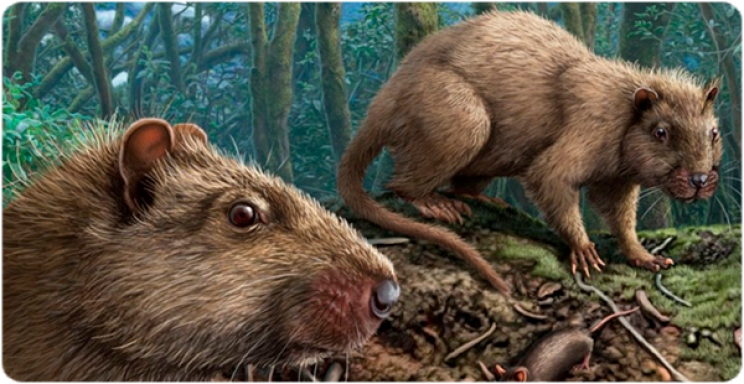
Main image: Life reconstruction of the rodent Canariomys on Tenerife Island. The house mouse (Mus musculus), which likely coexisted with Canariomys, is included for scale. (Jesús Gamarra González / © Institut Català de Paleontologia Miquel Crusafont).
Original research article:
- Vincent, F., Souron A., Casanovas-Vilar, I., Gamarra, J. & Bertrand, O. C. (2025, published online) The brain endocast of the Canary Islands giant rats (Canariomys, Muridae, Rodentia): paleobiological and evolutionary implications. Journal of Mammalian Evolution. https://doi.org/10.1007/s10914-025-09785-0