ICP News

How the Ampelomeryx grew: Discovering the life history of this relative of giraffes that lived in the Penedès
28 Apr 2026
58 times
A research team from the Institut Català de Paleontologia Miquel Crusafont (ICP-CERCA) has led the paleohistological study of Ampelomeryx ginsburgi, a giraffomorph ruminant from the Middle Miocene recovered at the Els Casots site (Penedès). Through microscopic analysis of bone tissues, the researchers were able to determine that this peculiar animal…
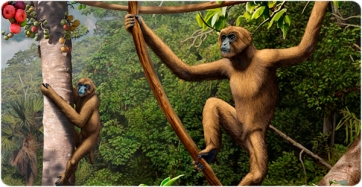
A study led by ICP researchers analyzes the morphology of the radius (one of the two forearm bones) of the pliopithecoid primate Pliobates cataloniae, from the Miocene of the Iberian Peninsula, and evaluates its implications for locomotor evolution in apes.

Oriol Monclús-Gonzalo defends his doctoral thesis on the locomotor evolution of primates
23 Feb 2026
134 times
Oriol Monclús-Gonzalo, researcher at the Institut Català de Paleontologia Miquel Crusafont (ICP), has defended his doctoral thesis on the locomotor evolution of primates. The study analyzes the functional morphology of several tarsal bones in living and fossil primates to reconstruct how extinct species moved, and has been supervised by Judit…

The extinct pig Cainochoerus inhabited eastern Africa during the late Miocene, around 6 million years ago and was remarkably small compared to modern African pigs. Now, a team of paleontologists reports the discovery of rare fossil jaws and teeth from the Lemudong’o site in the southern Kenyan Rift, documenting the…

The Groundhog Day of millions of years ago: Reconstructing climate using fossil rodents
30 Jan 2026
178 times
Small mammals are closely linked to climate, and their fossils allow scientists to reconstruct past precipitation and climatic conditions. A study by the Institut Català de Paleontologia Miquel Crusafont (ICP-CERCA) reveals that between 12.5 and 9 million years ago in the Vallès-Penedès region, rainfall was approximately twice as high as…

The price of becoming a giant and how Canary Islands rodents lost their senses
15 Jan 2026
238 times
The Canary Islands giant rats of the genus Canariomys roamed these Atlantic volcanic islands from the Pleistocene to just the 4th century BCE, and were huge compared to their closest living relative, the African grass rat. Now, a new study from the Institut Català de Paleontologia Miquel Crusafont (ICP-CERCA) and…

The oldest and most complete skeleton yet known for Homo habilis is described
13 Jan 2026
1284 times
An international research team has unveiled a significant discovery in human paleontology: an exceptionally well-preserved Homo habilis skeleton dating back more than 2 million years. The fossil, designated KNM-ER 64061, was recovered from East Turkana in northern Kenya, and constitutes the most complete postcranial evidence of Homo habilis known to…

The ICP has launched a new platform for donations, patronage, and sponsorship to bring paleontological research closer to society and encourage public participation. Contributions can be one-time or recurring, directed to general or specific projects, with significant tax benefits. This initiative supports research, heritage preservation, and the center’s scientific outreach…

The Dursunlu site (Turkey) is key to understanding the first human settlements in the Near East. A study published in Diversity has reconstructed the paleoenvironment in which these populations lived around 900,000 years ago. The research revealed the presence of an ancient shallow, nutrient-rich lake, surrounded by marshy areas and…

The ICP incorporates two new ICREA researchers to lead research in human evolution and evolutionary phenomics
10 Dec 2025
154 times
The Institut Català de Paleontologia Miquel Crusafont (ICP) strengthens its scientific excellence with the incorporation of two prominent ICREA researchers: Ashley S. Hammond and Sergio Almécija. Both scientists, who have developed most of their research careers in the United States, join the centre to lead new research groups that will…