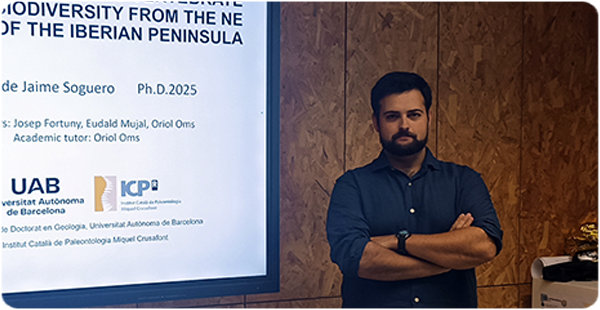
The research focuses on the study of the diversity and paleoenvironmental changes of tetrapod communities that lived during the Permian and Triassic periods—two key geological stages marked by major biological crises and the reorganization of continental ecosystems. By analyzing fossil sequences from the Pyrenean and Catalan basins, the thesis identifies five main depositional paleoenvironments, ranging from meandering fluvial systems in the Permian to “playa-lake” type floodplains, as well as the transition to shallow marine environments resulting from transgressions during the Middle Triassic.
One of the most significant aspects of the work is the identification of five distinct tetrapod communities, represented by fossil footprints and osteological remains, which provide valuable information about fluctuations in paleobiodiversity linked to environmental changes. These results help to better understand extinction and faunal recovery dynamics during critical moments in the history of life, such as the Permian–Triassic boundary.
The research also points to the presence of faunal exchanges between basins of the peri-Tethyan region and even at a Pangaean scale, reinforcing the paleobiogeographic importance of the studied records. Both the ichnoassociations (study of footprints) and the osteological record (bones) reveal the existence of unique communities that, while sharing similarities with other regions, display distinctive features due to the geological and evolutionary context of northeastern Iberia. This thesis highlights the scientific and heritage value of the Catalan and Pyrenean Permo-Triassic sites, as well as their potential to serve as key references in reconstructing global and regional evolutionary patterns during one of the most tumultuous intervals in Earth’s history.
Following the presentation, the examination committee awarded the researcher the highest possible grade for his thesis. From the ICP, we publicly congratulate him for his excellent work and wish him the best of luck in the future.
Main image: Researcher Chabier DeJaime during his thesis defense (Pere Figuerola / ICP)