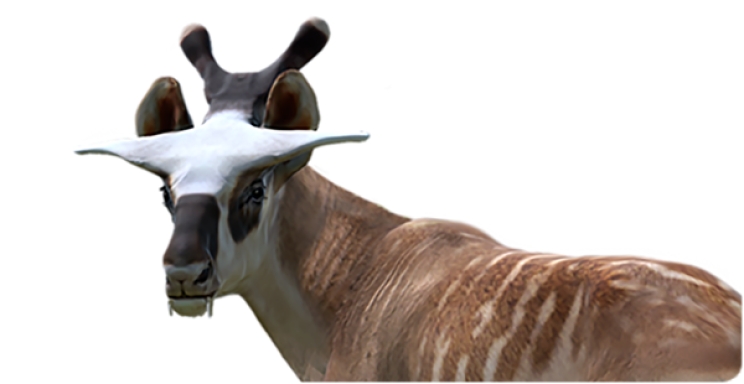

Where vineyards stretch today, 16 million years ago, in the Penedès region, there were subtropical riparian forests where Ampelomeryx ginsburgi lived, a medium-sized ruminant with the appearance of a robust deer. Its most distinctive feature was a set of bony structures on its skull: two flat, triangular bony horns located above the eyes, and a "Y"-shaped structure at the back of the skull, formed by the occipital bone. These projections were fixed and gave it a very unique appearance compared to other Miocene ruminants.
Despite being related to modern giraffes, which are adapted to large open spaces, this animal moved through swampy landscapes, near lakes, where the abundance of vegetation provided food and shelter.
Millions of years later, the remains of this animal are being excavated at the Els Casots site, in Subirats, considered one of the most important Miocene sites in Europe. There, a team from the Institut Català de Paleontologia Miquel Crusafont (ICP-CERCA) has gone beyond the reconstruction of its external appearance and has studied the animal's growth.
How did Ampelomeryx ginsburgi grow?
Studying the life history of extinct animals is one of the great challenges of paleontology. Knowing their growth rate, when they reached adult size, and when they began to reproduce allows us to reconstruct their life strategy; that is, to understand how they allocated energy to maximize growth, survival, and reproduction based on their environment.
To answer these questions, the research team studied the histology of the bones of this peculiar ruminant recovered during excavation campaigns conducted in the 1990s. To do this, very thin sections of bone were prepared and observed under a microscope to analyze the different types of bone tissue and growth marks.
"Bones preserve a detailed record of the animal's growth through growth lines or marks, similar to tree rings. Their microscopic study allows us to know when the animal grew rapidly, when this growth slowed down, and what major changes occurred throughout its life," explains Carmen Nacarino-Meneses, an ICP researcher and lead author of the study.
 Limb bones of Ampelomeryx ginsburgi: tibiae (a–d), humerus (e), and metapodials (f, g). Scale bar: 5 cm. Credit: Viladot et al. (2026)
For this work, four tibiae, one humerus, and two metapodials (the bones that form the palm of the hand and the sole of the foot) of Ampelomeryx recovered at Els Casots were analyzed. The tibiae, in particular, proved to be key, as they are the bones that best preserve the complete growth record.
It took three years to grow and had early reproduction
To deduce the time it takes for an animal to reach adult size, the research team studies the moment of appearance of a specific bone tissue called the External Fundamental System (EFS), which indicates when bones reach maturity and the growth rate decreases.
The results show that Ampelomeryx reached skeletal maturity and adult size around three years of age. Furthermore, the bones reveal even more information.
"The data indicate that Ampelomeryx grew rapidly during the first years and finished growing around the age of three. But the most interesting thing is that we have also been able to infer that reproduction began before that moment, when the animal had not yet fully reached its adult size, probably after the second year of life," notes Nacarino-Meneses.
From the age of two onwards, a deceleration in the growth rate is observed in the curves obtained from the bone data, which reflects the age at which the animal began to reproduce successfully.
A relative of giraffes with growth similar to that of deer
The pattern observed in Ampelomeryx —reproducing before completing body growth— is characteristic of many ruminants, such as modern deer. Far from being an animal of open spaces, Ampelomeryx was probably better adapted to riparian forests and wetlands, more typical of a deer than a savanna giraffe. The abundance of water and vegetation would have favored a more protected life and efficient reproduction.
Thanks to the excavations at Els Casots and this first study on the biology of Ampelomeryx, it has been possible to relate this extinct species to its environment and way of life. The study opens the door to investigating whether other herbivores from the site, such as archaic deer and antelopes, grew in the same way.
Main image: Reconstruction life appearance of a male Ampelomeryx ginsburgi. Drawing: Óscar Sanisidro / Subirats City Council.
Reference article:
Viladot, A., Casanovas-Vilar, I., Sánchez, I. M., & Nacarino-Meneses, C. (2026). Growth and life history of a palaeomerycid: inferences from the histological analysis of the long bones of Ampelomeryx ginsburgi (Ruminantia, Giraffomorpha) from els Casots (Catalonia, Spain). Journal of Mammalian Evolution, 33, 12. https://doi.org/10.1007/s10914-025-09789-w

